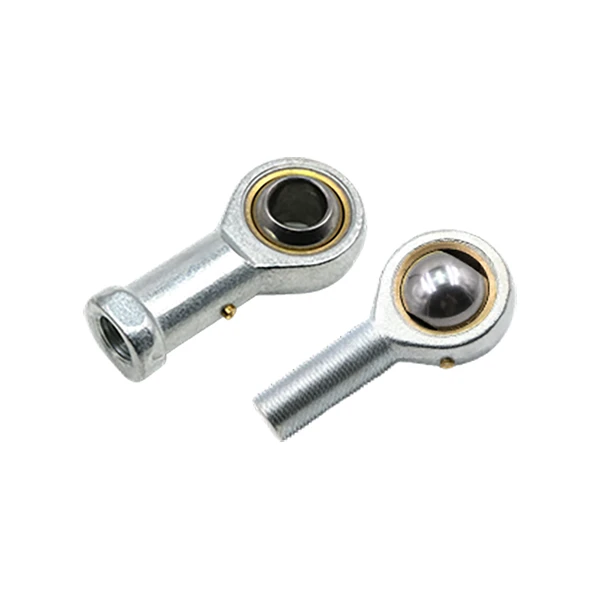
Male rod ends (POS series) feature external threads cut straight onto the bearing shank. They screw directly into female-threaded linkages, turnbuckles, or custom lever arms where you want to keep overall assembly length short.
Female rod ends (PHS series) carry internal threads bored into the shank body. Most standard pneumatic cylinders and hydraulic tie-rod rams ship with male piston rod threads, making PHS female joints the direct bolt-on choice without extra adapter couplings.
Both configurations rely on a precision-ground chrome steel inner ball rotating inside a self-lubricating race. That spherical joint absorbs up to 13 degrees of angular misalignment, letting your swing linkage arc smoothly without twisting the actuator shaft.
2. Shop Installation and Jam Nut Locking HabitsSpin on a Jam Nut First: Before threading a PHS female joint onto a cylinder piston rod, run a thin jam nut all the way down the male threads. Leave three to four full threads exposed past the nut so you can adjust stroke length later without running out of engagement.
Keep the Ball Eye Square: Hold the rod end body flat with an open-end wrench while tightening the jam nut against it. Letting the housing twist during final torque cocks the inner ball to one side, eating up half your available tilt angle before the machine even starts.
Match Lube to Race Material: Standard bronze-lined rod ends need a shot of NLGI Grade 2 lithium grease through the zerk fitting every 200 hours. If your joint uses a maintenance-free PTFE fabric liner, keep grease away—oil attracts abrasive shop grit that chews up the thin polymer layer.
A: Impact shock has pounded out the soft bronze race, leaving radial play around the spherical ball. Grab the linkage arm and shake it perpendicular to the pivot bolt; if you feel a distinct knock, swap the joint out before it shears the mounting bolt.
A: Pair one right-hand POS joint with one left-hand POSL joint on opposite ends of a connecting rod. Spinning the center rod lets you dial in exact center-to-center linkage length on the machine without unbolting either clevis pin.
Leave enough thread engagement past the jam nut, hold the eye square while torquing, and never grease PTFE-lined races—that stops most linkage play and cylinder seal failures on automated setups.