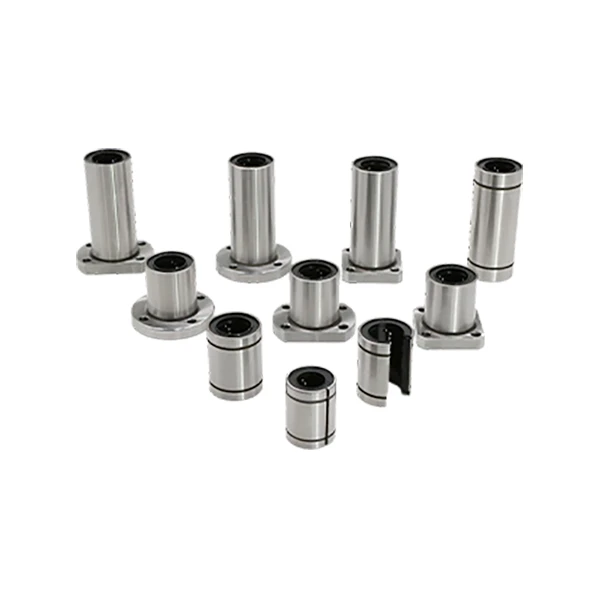
Standard sleeve-style linear bearings depend on an external housing bore and retaining snap rings to stay positioned. Any small tilt in that bored pocket pinches the recirculating steel balls against the hardened outer sleeve, gouging grooves into the precision shaft.
Flanged linear bushings solve this by integrating the mounting flange directly onto the bearing outer body.
Bolting a ground square (LMK) or round (LMF) flange tight against your mounting plate forces the bearing center axis perpendicular to the housing. That stiff mounting shoulder takes pitch and yaw moments without relying on press-fit friction, stopping carriage tilt on short-stroke axes.
2. Assembly Rules: Shaft Hardness, Hole Clearance, and GreasingCheck Shaft Surface Hardness: Never run linear ball bushings on soft stainless or untreated mild steel rods. The recirculating steel balls will quickly plow tracks into the shaft surface. Always match ball bushings with induction-hardened, precision-ground chrome shafts holding HRC 60 to 64 surface hardness.
Keep Mounting Hole Clearance Loose: Machine the clearance hole in your mounting plate slightly larger than the bearing outer sleeve. Let the flange shoulder do the locating work so plate tension does not squeeze the thin outer sleeve out of round.
Inject Light Grease: Packing small linear bushings with heavy chassis grease traps the internal steel balls, forcing them to skid rather than roll. Inject a few drops of NLGI Grade 0 lithium grease or ISO VG 68 slide-way oil through the seal ends every 150 operating hours.
A: You either used a shaft with a oversized diameter tolerance, or the mounting plate bolts pulled the flange down crooked. Loosen the flange screws slightly, slide the bearing back and forth to let it self-center, then tighten the bolts in a diagonal pattern.
A: Yes, but space them at least 1.5 times the shaft diameter apart. Mounting them back-to-back without clearance magnifies minute shaft runout and jams the internal recirculating tracks.
Match ball bushings to HRC 60 shafts, let the ground flange do the locating, and lubricate with light Grade 0 grease—that fixes 90% of linear sleeve bearing issues on compact automated machinery.