With the rapid development of industry, ball screws, as the "core of linear motion" in mechanical motion, hold an irreplaceable position. Furthermore, their circulation method directly affects the accuracy and service life of equipment. Ball screws can be divided into two types according to their circulation: internal circulation ball screws and external circulation ball screws. Internal circulation structures dominate the precision instrument market due to their compact design, while external circulation solutions lead the heavy-duty field with their high load-bearing characteristics.
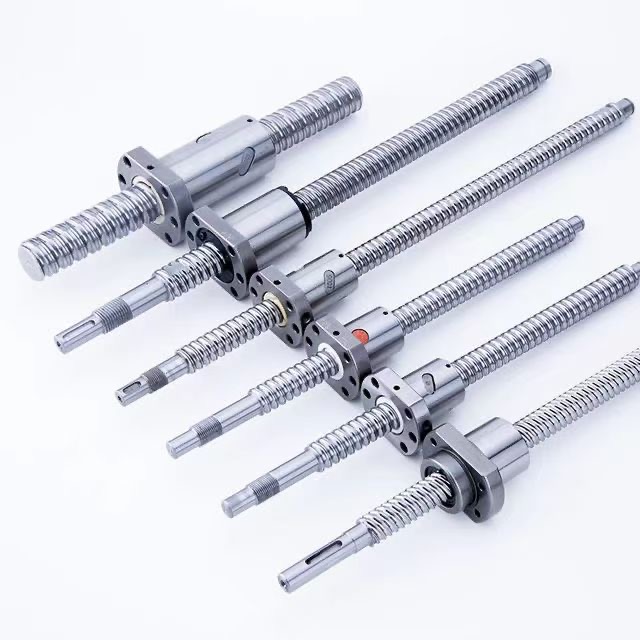
Internal circulation ball screws achieve ball circulation through a reversing mechanism installed inside the nut. Their compact structure and small radial dimension make them ideal for applications with limited installation space, such as robot joints, semiconductor devices, or small precision instruments. External circulation ball screws, on the other hand, allow balls to return through external conduits to the nut, resulting in a smoother circulation path and less ball collision and friction resistance. This makes them more suitable for applications requiring high-speed operation, such as high-speed machining centers and rapid material handling equipment.
Ball screw external circulation structures, due to their smooth circulation path, typically offer better smoothness and lower noise levels at high speeds; while internal circulation structures, at extremely high speeds, are prone to significant impact and noise from the balls at the reverser. Internal circulation screws have shorter ball circuits and a relatively larger and denser distribution of working balls, resulting in higher rigidity and load-bearing capacity for the same dimensions, making them suitable for heavy-duty cutting or applications requiring high rigidity.
The axial dimension of the internal circulation nut can usually be designed to be smaller, contributing to the miniaturization and weight reduction of equipment; while the external circulation nut, due to its external conduit, generally has a longer axial length. Internal circulation structures place extremely high demands on the machining precision and heat treatment of the reverser, resulting in complex manufacturing processes and relatively higher costs; external circulation structures are relatively simpler, have lower manufacturing costs, and are easier to maintain and replace. Because the nut shell of the internal circulation structure is completely enclosed, it is easier to achieve effective sealing, providing better dust protection and better protection for the circulation system under harsh conditions; the conduit connection points of external circulation systems may become weak points in dust protection.
In summary, the key to choosing between internal and external circulation lies in the priority of application needs: if space is limited and heavy-duty rigidity is the primary requirement, internal circulation should be chosen; if high speed, low cost, or simple structure is the priority, then external circulation is a more suitable choice.