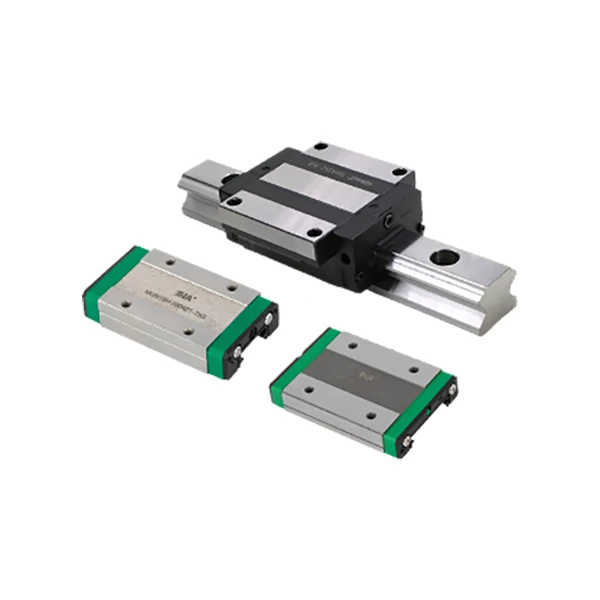
Miniature MGN series rails feature a 2-row gothic arch contact profile that delivers smooth travel in restricted spaces. However, running a single MGN carriage under overhang cantilever loads exposes the block to severe roll moment forces MR. If your toolhead offsets past the rail edge, the tiny recirculating steel balls bear unequal friction, causing premature raceway pitting.
To avoid running parallel twin MGN rails—which eats up valuable deck space and doubles your mounting labor—switch to a wide-rail MGW series. MGW profiles widen the track base and spread the ball contact footprint, doubling the roll moment capacity MR without increasing total module height.
For light Z-axis probes or vertical sensor mounts, standard MGN rails keep mass down. For single-rail X-axis gantries carrying heavy extruders or laser pickup units, MGW rails provide the lateral stiffness needed to stop toolhead twisting under high acceleration.
2. Mounting Surface Prep, Tiny Screw Torquing, and Micro-Lube RulesWhen fixing M2 or M3 miniature rail bolts into aluminium plates, clean away any tiny machining burrs first. Dropping a miniature steel rail onto an uneven mounting ledge creates subtle bows along the track, causing small block carriages to bind mid-stroke.
Tightening M3 Screws: Grab a torque screwdriver and set it right at 0.6 N.m for M3 rail bolts. If you crank those tiny screws by feel, you will swell the counterbores and create micro-bumps that slap the steel balls on every single pass.
Choosing Your Preload: Go with ZF (zero preload) or Z0 (light clearance) if you need silky-smooth manual slide motion. For fast pick-and-place heads, step up to Z1 (light preload) so the slider does not slop around under quick directional flips.
Micro-Grease Application: Never pack miniature blocks with thick chassis grease. Use a fine needle syringe to inject lithium grease (NLGI Grade 00 or 0) through the end lubrication hole every 500 operating hours. Thick grease traps recirculating balls, causing micro-sliders to skid and jump.
A: Storage oil inside the block has dried out, or dust got past the tiny end seals during unboxing. Flush the block out with isopropyl alcohol, blow it dry with clean air, and inject a few drops of ISO VG 32 spindle oil before sliding it back onto the rail.
A: Only if you buy interchangeability-grade (N-class) components. Precision-grade (P-class) miniature rails and blocks are ground as matched sets to hold radial clearance tight—swapping blocks across P-class rails will either bind the balls or create loose axial slop.
Pick MGW for wide single-rail cantilever setups, keep M3 rail screws torqued under 0.6 N.m, and use light Grade 00 grease—that handles 90% of miniature linear slide design and lifespan issues on desktop automation equipment.